

October 11, 2026
How to Tell a Real Turkish Towel From an Imitation

“Turkish towel” describes a style. It doesn’t guarantee anything. The name gets used for flat-woven cotton from Turkey, for cotton-linen blends, and for polyester blends that copy the look with stripes and a fringe. Some of those are perfectly good towels. Some are towels you wouldn’t want to dry off with.
We’ve been trading in Istanbul’s Grand Bazaar since 1965. This is what we look at when we judge a towel, ours or anyone else’s, and none of it needs special equipment.
Start with the composition line
The most useful single fact about a towel is its fibre content, written as percentages. Many countries require it on the sewn-in label, and a good online listing puts it in the description. You will usually see one of three answers.
100% cotton
This is the traditional peshtemal. Cotton absorbs water well and gets softer as it’s washed. Most of the beach towels in our shop are 100% cotton, including the Akasya, the Demre and the whole double-face range.
Cotton and linen
A linen blend is a legitimate peshtemal. Linen dries faster than cotton and feels cooler and crisper, so a cotton-linen towel suits hot weather and anyone who hates a towel that stays damp. In our shop, the Assos 013 and Assos 014 are 70% cotton and 30% linen, and our two kimonos are half and half.

Polyester, or a “blend” with no numbers
Polyester doesn’t absorb water the way cotton does. A flat-woven towel with a lot of it in the mix tends to feel slick and to push water around your skin instead of taking it up. Microfibre is a separate category and can be absorbent, but it’s not a peshtemal and shouldn’t be sold as one.
Be wary of wording that avoids a number: “cotton blend”, “cotton-rich”, “cotton feel”, “Turkish-style cotton”. If the percentage is missing, ask. A seller who knows the product will tell you straight away.
You will also come across bamboo and cotton blends. They’re a different product with a different feel. Judge them on their own terms, not as a Turkish cotton towel.
Ask for the weight in grams
Two towels of the same size can look identical in a photo and feel completely different in the hand. Weight is what tells them apart.
Our beach-size peshtemals run from 280 g (9.9 oz) for the Akasya at 175 × 95 cm, up to 500 g (17.6 oz) for the Assos 014 at 190 × 100 cm. Neither end is better. A 280 g towel is light, packs small and dries fast. A 500 g towel has more body and keeps you covered on a cool evening. What matters is that the seller tells you, so you know which one you’re buying.
A listing with no weight isn’t proof of anything, but it’s worth a question. A towel that looks generous in the photo and arrives thin and papery is usually a loose weave.
Know which weave you’re looking at
“Turkish towel” covers several different weaves, and each has its own signs of good work.
Flat-weave peshtemal
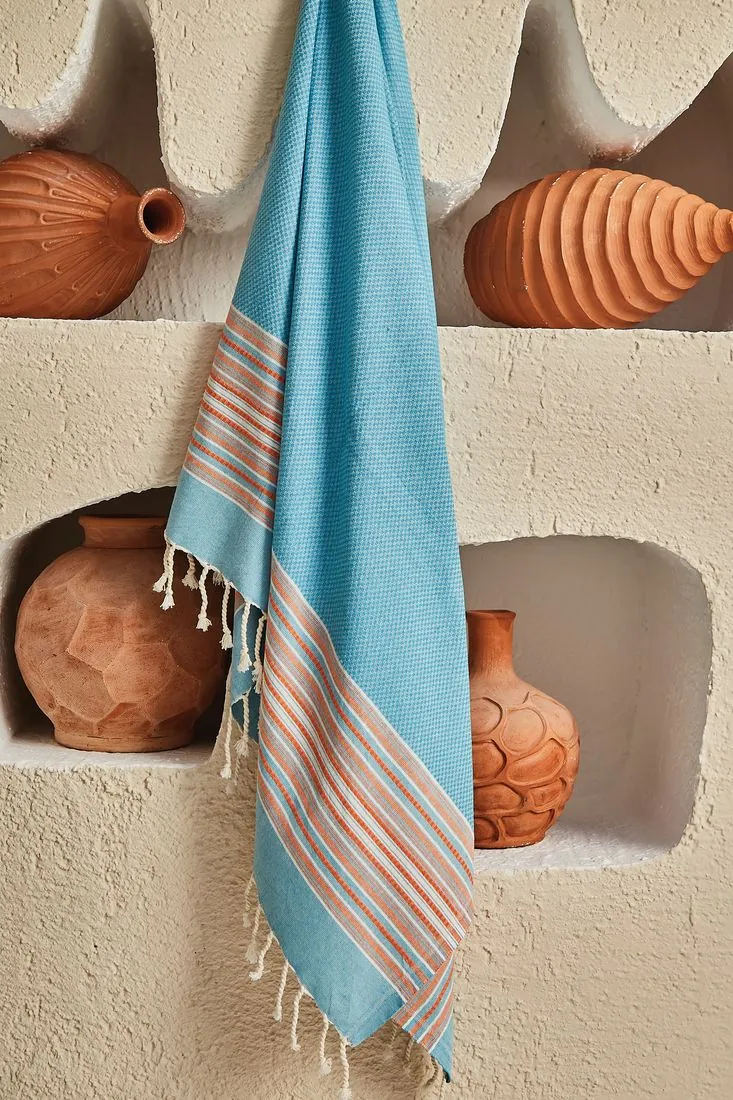
This is the classic: flat cotton cloth, often striped, with no loops on either side. It should look even across the width without thin patches, and the stripes should run straight. The Afrodit, Tripolis and Truva are all flat-woven. Good flat weave can feel slightly crisp when new and softens over the first few washes.
Double-face jacquard
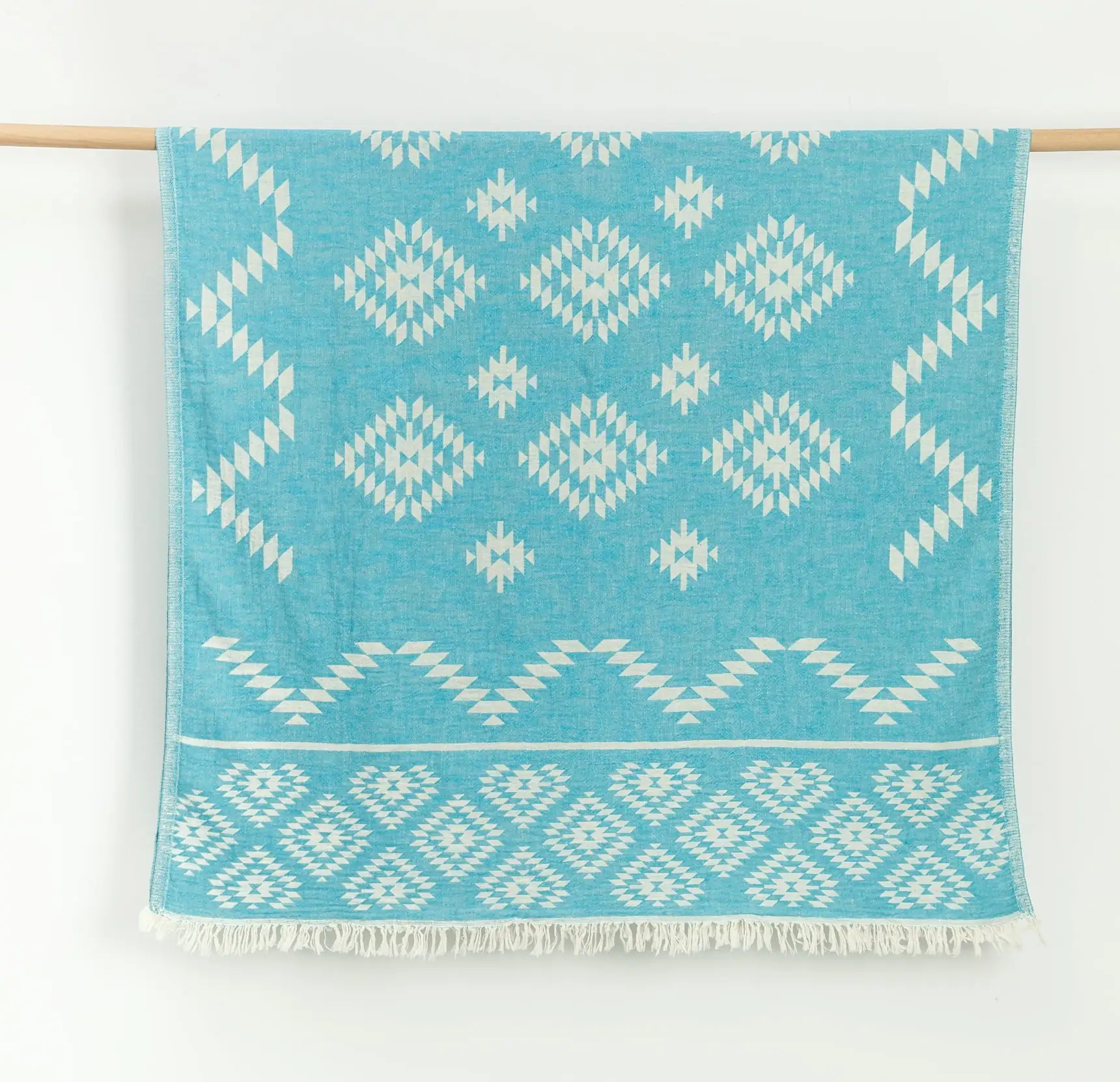
A jacquard loom weaves the pattern into the cloth itself. On a double-face towel the design shows on both sides with the colours reversed. Turn the towel over. If the back is a clean negative of the front, the pattern is woven. If the back is pale and blurry, it was printed on. Printed towels aren’t fakes, but they’re a simpler construction, and printed colour can fade.
Our double-face range, including the Kilim, Skull and Anatolia designs, is 100% cotton, 170 × 100 cm and 375 g, and every one is reversible.
Terry and terry-backed
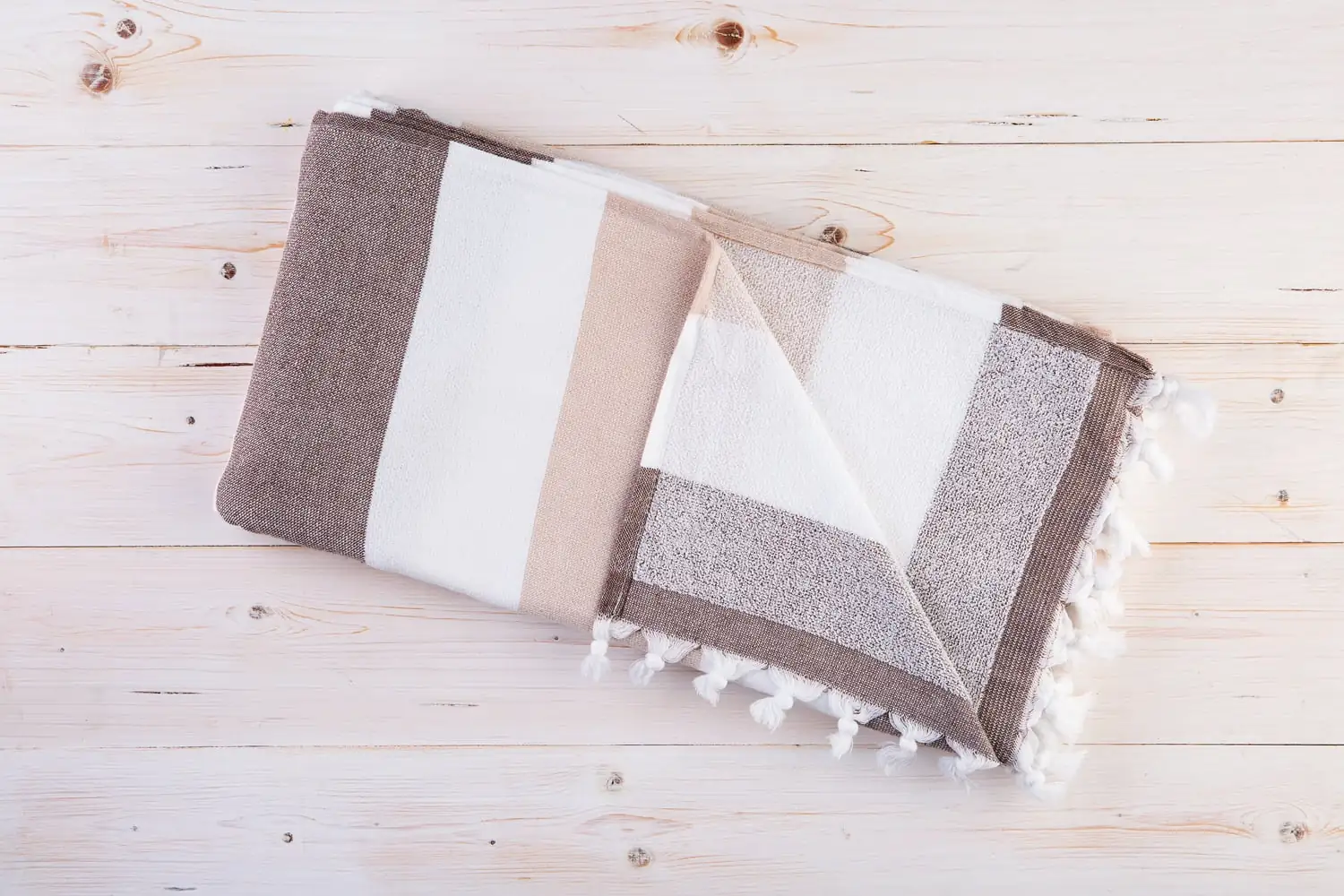
Terry is the looped pile of an ordinary bath towel. It holds the most water and takes the longest to dry. Some Turkish towels combine the two. The Artemis Terry Towel has flat weave on one face and terry loops on the other, so it dries faster than full terry and absorbs more than a plain peshtemal. Full terry shows up in our Damask Bath Towel, where the damask pattern is sculpted into the loops, and in the Rainbow Terry Hand Towel.
With any terry, look at the loops. They should be dense and even, with no bald patches, and they shouldn’t pull out easily.
Waffle
Waffle weave has a grid of small square pockets. It’s lighter than terry, textured, and quick to dry. Check that the grid is crisp and regular across the whole towel. Our Waffle Beach Towel and Waffle Hand Towel are both 100% cotton.
Look at the fringe, but don’t read too much into it
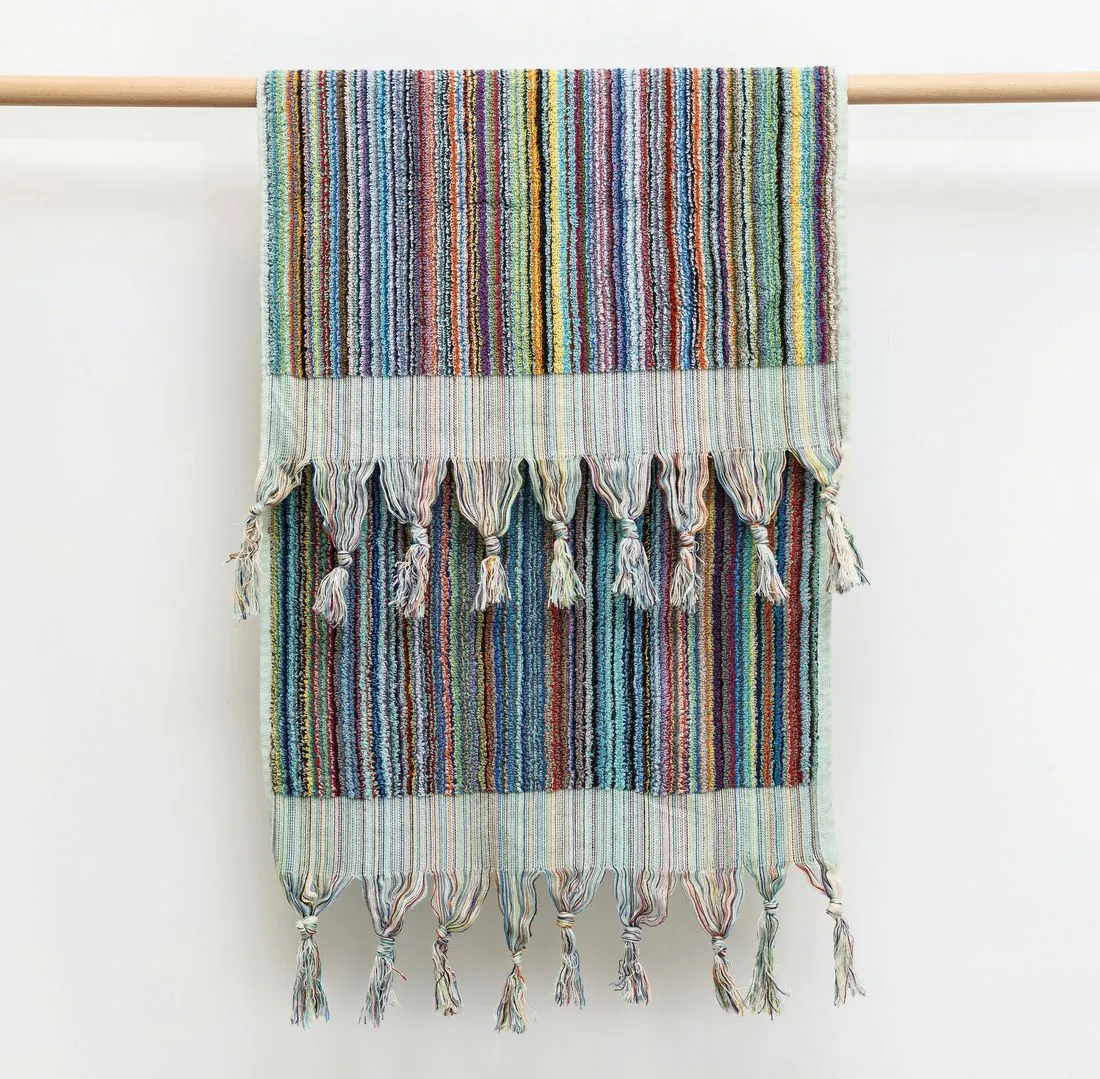
On a traditional peshtemal, the fringe is made from the warp threads left at each end of the cloth, which are then twisted or knotted. Look closely and you should see the fringe growing out of the towel itself. A separate tassel trim sewn onto a hem is a different, decorative finish.
Fringe on its own proves nothing about where a towel was made or what it’s made of. Machines can twist fringe, and plenty of good towels have hemmed ends. For reference, the product pages for our Rainbow Terry Hand Towel, Mini Diamond Robe and Arsemia Kimono list twisted, knotted and hand-twisted fringe respectively.
Two simple tests at home
The water test
Drip a little water onto the towel. Cotton and linen darken and draw it in. A cloth with a lot of polyester tends to let it sit on the surface or spread slowly. One caveat: brand-new cotton can absorb slowly until it has been washed once or twice, because of finishes left over from production. If the first test disappoints, wash the towel and try again.
The burn test, done carefully
Textile buyers have used this one for a long time. Snip a single thread from the fringe, hold it with tweezers over a sink and touch it to a flame. Cotton and linen burn with a smell like paper and leave a soft grey ash. Polyester melts, shrinks away from the flame and leaves a hard bead. Do it away from anything that can catch fire, and skip it entirely if you aren’t comfortable with it.
What happens in the wash
The first few washes tell you a lot. A good cotton peshtemal comes out softer than it went in, and usually more absorbent too. Our product page for the Muslin Single Blanket says it gets softer with every wash, and the same holds for flat-woven cotton towels.
A polyester-heavy towel tends to stay slick and can start to pill. Poor dyeing shows up as heavy bleeding and quick fading.
Some colour in the water on the first wash of a deep red or black is normal, so wash dark colours separately the first couple of times. A little shrinkage is normal for cotton too, especially in a hot dryer. Skip fabric softener, since it coats the fibres and cuts absorbency, and dry on a line when you can.
Questions to ask any seller
- What is the exact fibre composition, in percentages?
- What does the towel weigh, in grams or ounces?
- What are the dimensions, and do they include the fringe?
- What kind of weave is it: flat, double-face, terry, terry-backed or waffle?
- Where was it woven?
A seller who can’t answer the first three may not know much about what they’re selling.
How we list ours
Every product page in our shop states the fibre composition, and most also give the size and the weight in grams. For any other measurement, just ask before you order. We sell from our stall in the Grand Bazaar and ship to 21 countries, including the US, the UK, Australia and New Zealand, with 30-day returns; the full list is on our shipping page.
To compare weaves side by side, browse our beach towels. Flat weaves, double-face jacquards, a terry-backed towel and a waffle towel all sit in the one collection.
Further reading: Turkish Towel Weight Explained: What 280 g, 400 g and 900 g Mean · Peshtemal Robes and Turkish Kimonos: A Buyer’s Guide